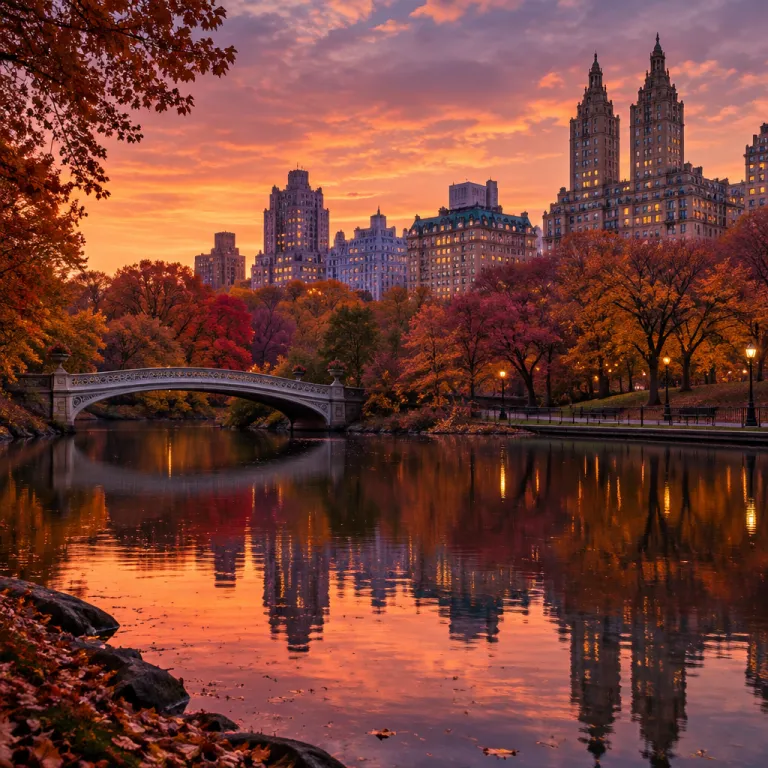
Timing your trip for central park fall foliage
Central Park fall foliage is not a season, it is a brief performance. Peak fall colors in the park usually arrive from mid to late October and hold for roughly two to three weeks, so your hotel dates in New York City should orbit that window rather than the other way around. Aim for stays that straddle at least four nights, giving you a margin if the leaves change slightly earlier or later than expected.
Think of the park as a living foliage tracker rather than a postcard, because different trees change color on different days and in different corners. The red maples near the Reservoir might turn yellow orange while the maple trees along the Mall still glow green, and a single maple can show red yellow on one branch and deep red on another. In a city that moves fast, this slow, visible change is the rare New York pause button.
Weather matters more than you think for both color and comfort. October days in New York City usually sit between 10 and 18 °C, ideal for long walks under bright skies, while November cools to around 4 to 12 °C and the most vivid reds yellows and burnt orange tones begin to fade. Pack layers in black, navy, or other dark colors that hide city grit, then add one warm accent scarf in orange red or deep red for the photos you will actually keep.
Returning visitors who know the city’s rhythm can use Central Park fall foliage as the anchor for the whole stay. Instead of chasing attractions across multiple parks, you wake up near one park and let the colors dictate your route each day. That is the difference between a trip to New York and a few days genuinely spent in York City.
A walking route through the park’s brightest fall color
Start just after sunrise at the south end of Central Park, when the light is low, yellow, and kind to jet lag. Enter near 59th Street and Fifth Avenue, then walk north along the Mall and Literary Walk, where double rows of American elms form a vaulted tunnel of foliage that shifts from green to yellow orange and finally to a soft orange red. When the leaves change here, they fall in slow motion, carpeting the black asphalt path in a mosaic of red, yellow, and burnt orange.
From the Mall, drift toward Bethesda Terrace and Fountain, where the lake reflects the surrounding maples and oaks in almost unreal autumn colors. On a still day, the water doubles every color, so a single red maple becomes a vertical stripe of deep red above and below the surface, while nearby maple trees turn yellow and cast a pale glow across the arches. This is where you feel the city recede, even though taxis slide along Fifth Avenue just beyond the stone balustrades.
Continue to Bow Bridge, then angle into the Ramble, a tangle of paths and trees that feels more like upstate New York than central Manhattan. Here the fall foliage is layered and close, with low shrubs staying green while taller trees change color overhead, giving you a ceiling of reds yellows and a floor of lingering summer. Follow the paths north and you eventually reach the North Woods, where red maples and oaks lean over the water at Harlem Meer and the fall color feels wilder, less manicured, more like a real forest than a city park.
For a returning visitor, this route is less about ticking off landmarks and more about reading the park’s subtle changes day by day. One morning the maples along the lake might be bright orange red, the next they have dropped half their leaves and the focus shifts to a stand of trees that only just began to turn yellow. You are not just seeing Central Park fall foliage, you are watching the park think about winter.
When you plan your stay, pair this route with a hotel that lets you walk straight into the park rather than commute to it. Properties along Central Park South and Fifth Avenue place you at the Mall within minutes, while Upper West Side addresses near 72nd Street drop you close to Bow Bridge and the Ramble. If shopping is part of your trip, look for a hotel that balances foliage access with retail, using a guide to shopping in New York City outlets and choosing the right hotel so you are not trading fall colors for outlet buses.
Where to sleep for a fall foliage wake up
For Central Park fall foliage, the most strategic base is the Upper West Side between West 59th and West 86th Streets. Here, tree lined avenues run parallel to the park, so you can step from your lobby to the West 72nd Street entrance in under five minutes and watch the leaves change on your way to coffee. Hotels along Columbus Avenue and Amsterdam Avenue give you that daily ritual, with a side of neighborhood food drink that feels more local than the Fifth Avenue corridor.
On the east side, staying along Fifth Avenue or Madison Avenue between 60th and 79th Streets trades some neighborhood grit for immediate access to the Mall, Bethesda Terrace, and the Conservatory Water. This is the classic New York City image of Central Park, where the skyline rises behind bright foliage and the contrast between black glass towers and orange red trees is sharp and cinematic. If your idea of fall colors includes both maples and window displays, this edge of the park makes sense.
Repeat visitors who want quieter mornings should look north, toward hotels in Harlem and Morningside Heights. From here, you can walk into the North Woods and Harlem Meer, where the maple trees and red maples lean over the water and the crowds thin out, especially on cool weekdays. The fall color here feels more intimate, with narrow paths, low stone bridges, and pockets of deep red and yellow orange that appear suddenly around a bend.
Wherever you stay, check how the hotel’s front door connects to the subway grid. Being near lines B and C on the west side or lines 4, 5, and 6 on the east side keeps the rest of York City within easy reach once you have had your fill of foliage. If you are planning a harbor cruise or evening on the water, it is worth reading how your hotel choice shapes your New York City harbor cruise experience, then choosing a place that works for both the river and the park.
Think of your room not as the destination but as the launch pad. The best stays for Central Park fall foliage are the ones where you can be under trees five minutes after tying your shoes, not twenty minutes after negotiating cabs. In a city of endless options, that simple metric is the real privacy policy for your time and attention.
Local rituals, packing smart, and reading the colors
Autumn in New York is a walking season, so pack for movement rather than for dinner reservations. Comfortable shoes with grip matter when leaves turn yellow and then fall, because wet red yellow and orange red leaves on stone steps can be slick, especially around Bethesda Terrace and the Ramble. A light waterproof shell, a warm mid layer, and a compact umbrella in black or dark green will handle most October and November shifts.
Light changes the park as much as temperature does. Early mornings bring low, bright beams that make the foliage glow from within, especially where green grass meets deep red maples and yellow orange oaks, while late afternoons flatten the colors but stretch the shadows of the trees across the paths. If you care about photography, plan at least one sunrise walk and one late day loop, then compare how the same stand of trees change character between those two windows.
Build small local rituals around your hotel to make the city feel less like a backdrop and more like a neighborhood. On the Upper West Side, that might mean a coffee on Columbus Avenue before you cut through a side street lined with maples and head into the park, watching how the fall color on each block differs from the next. On the east side, it could be an evening stroll along Fifth Avenue, where the black glass of the towers mirrors the autumn colors in the park and the city lights turn the foliage into a kind of living marquee.
When you land, your first decision is how to get from the airport to that chosen base. Rather than improvising at the arrivals curb, use a guide to New York airport transfers to your hotel so you arrive with enough energy to walk the park that same afternoon. The real luxury is not the thread count, it is having the fall colors of Central Park close enough that you can step outside, see which trees change overnight, and adjust your day accordingly.
FAQ
When is the best time to see Central Park fall foliage ?
The most reliable time to see Central Park fall foliage at its peak is usually from mid to late October. Color can start earlier or linger into early November, but the most intense reds, yellows, and orange tones typically cluster in that two to three week window. Booking a stay that covers several days in this period gives you the best chance to see the leaves change across different parts of the park.
Which areas of Central Park have the best fall colors for returning visitors ?
Returning visitors who already know Bethesda Terrace and Bow Bridge should focus on the Ramble, the North Woods, and Harlem Meer. These areas feel wilder, with dense trees, narrow paths, and layered foliage where green undergrowth contrasts with deep red and yellow orange canopies. The experience is less about iconic views and more about small, shifting details as different trees change color day by day.
Where should I book a hotel to be within walking distance of Central Park ?
The most convenient areas for walking access to Central Park are the Upper West Side between West 59th and West 86th Streets and the east side along Fifth and Madison Avenues between 60th and 79th Streets. From the west, you reach Bow Bridge, the Ramble, and the Reservoir quickly, while the east side puts you near the Mall and Literary Walk, Bethesda Terrace, and the Conservatory Water. Both sides offer a mix of hotels, so you can choose based on whether you prefer a more residential feel or a classic Fifth Avenue atmosphere.
What should I pack for a fall foliage trip to New York City ?
For a fall foliage trip focused on Central Park, pack comfortable walking shoes with good traction, layered clothing for temperatures between about 4 and 18 °C, and a light waterproof jacket. A warm hat and gloves are useful for early morning walks, especially if you plan to be out at sunrise when the air is cooler. Neutral outer layers in black or dark green work well in the city, while a scarf or sweater in red, yellow, or burnt orange adds color in photos without sacrificing practicality.
How crowded does Central Park get during peak fall color ?
Central Park can be busy on sunny weekend afternoons during peak fall color, especially around Bethesda Terrace, Bow Bridge, and the Mall. To avoid crowds, visit early in the morning, on weekdays, or focus on the Ramble, the North Woods, and the northern end of the park near Harlem Meer. Staying in a nearby hotel makes it easier to time your walks for these quieter windows, when the foliage and the city feel more balanced.